


At the centre of the basilica’s presbytery is the ciborium, the most sacred place in the basilica, which encloses the high altar where the marble sarcophagus with the body of Saint Mark, moved here from its ancient location in the crypt, is placed.
The ciborium of antique green marble is supported by four columns embellished and decorated with episodes taken from the canonical and apocryphal gospels.
They depict ninety scenes, each accompanied by an engraved inscription. The back left column depicts episodes from the life of the Virgin; the front left column episodes from the life of the Virgin and Jesus; the back and front right columns episodes from the life of Jesus.
The four columns have been the center of a debate mainly concerning their dating and provenance which has not yet been resolved.
The ciborium was erected above the high altar of the Basilica of San Marco, where it still stands today, at an as yet unspecified time in the first half of the 13th century, probably in the 1320s.
On the edge facing the faithful are the statues of Christ between Saint Mark and Saint John, while behind, towards the apse, is the Redeemer between Saint Mark and Saint Luke, works from the 14th-15th century.
The debate over the ciborium has primarily focused on the dating and provenance of the four precious columns used to support the canopy’s vaults. The bas-reliefs that adorn them, while different in some respects, are essentially unified and could only have come from a single production center, even if created by artists of varying caliber. Reused several times, the ancient columns represent one of the most significant examples of early Byzantine figurative sculptures that have survived to the present day, both for the richness of their Mariological and Christological cycles and for the extraordinary quality of their craftsmanship.
The four monolithic shafts, made of Dokimeno and Pentelic marble, worked in pairs by an excellent Master and less worthy assistants, are divided into nine compartments separated by horizontal strips, which in turn are divided into nine small arches housing one or more figures in high relief.
The dark background of the niches gives the scenes an almost total plasticity. The 324 niches contain a total of 108 scenes with one or more figures, depicting the life of the Virgin and the life and passion of Jesus Christ. Well-represented in several detailed cycles, arranged horizontally or vertically, they are individual episodes taken from the canonical and apocryphal Gospels.
The column on the back left depicts thirty scenes from the life of Mary, from the Sacrifice of Joachim to the Consultation of the Priests on the Future of the Twelve-Year-Old Virgin , for the creation of which the sculptor faithfully adhered to the descriptions of the Greek version of the apocryphal Protoevangelium of James.
The Annunciation to Mary begins the sequence of twenty-six scenes on the front left column, which features events from Jesus’ youth and, among other things, several accounts of miracles and healings. These episodes, depicted with extraordinary vividness, hark back to the apocryphal Protoevangelium of James on the one hand and to the canonical Gospels on the other, especially the book of John.
The sculptural cycle continues on the column behind on the right with twenty-eight scenes depicting the teachings and miracles of Jesus as narrated in the Gospel of Luke.
The column in front on the right finally illustrates the twenty-four scenes of the Passion of Jesus Christ.
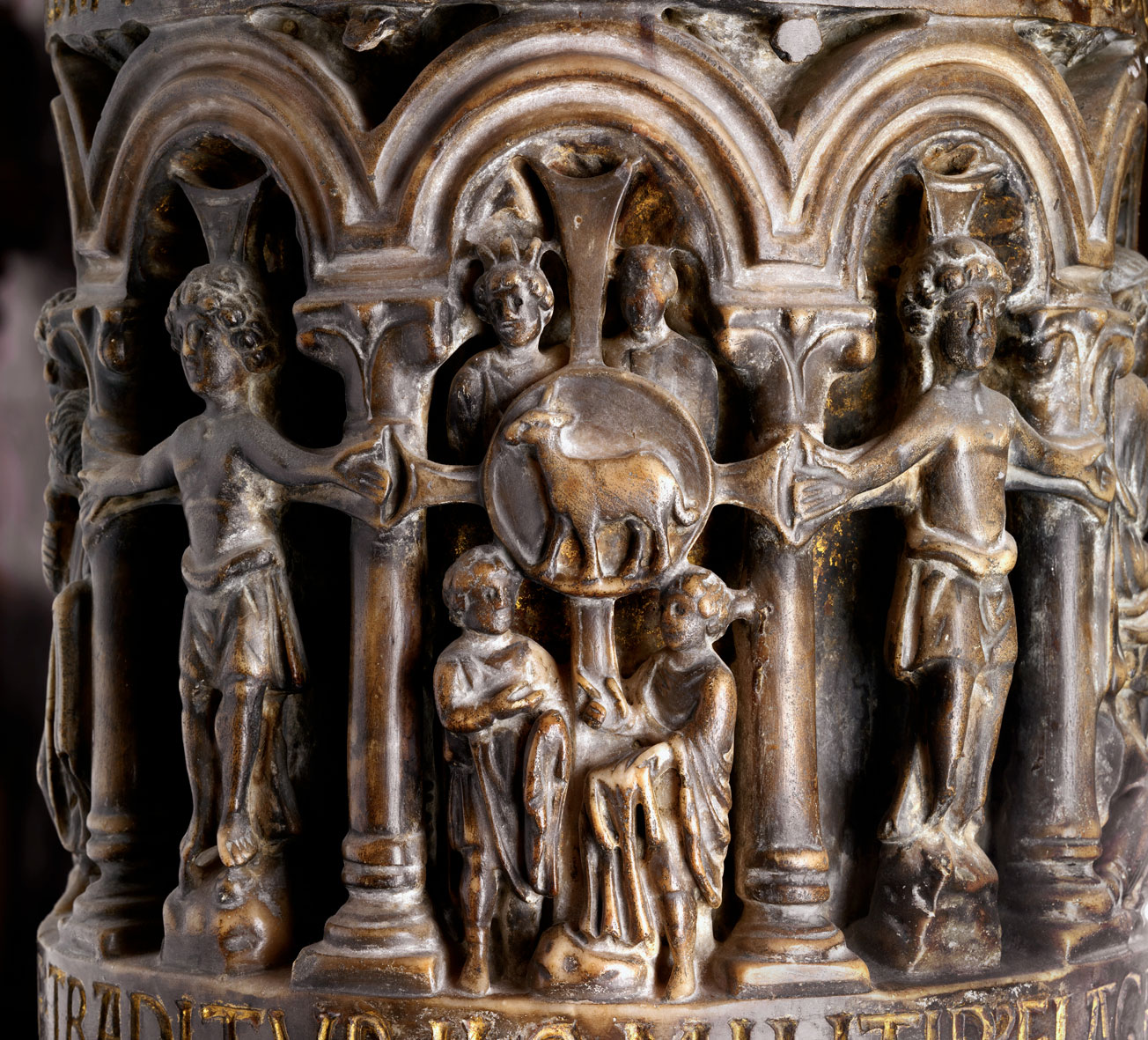
Of particular note is the extraordinary representation of the Crucifixion , where the symbol of the Mystic Lamb has been placed in place of the figure of Christ.
A stylistic comparison with ivories from the Eastern Roman Empire and with 6th-century sculptures still preserved in Istanbul allows the work to be dated to the time of Emperor Anastasius I (491-518). The Latin inscriptions engraved on the strips, often misleading in interpretation, were only inserted during the sculptural group’s relocation to its new location in Venice in the 13th century.
The ciborium is, in fact, the heart of the basilica and reaches its maximum communicative value when, on the occasion of the feast in honor of the saint, the sarcophagus with his relics is freed from the grates that enclose it, covered in red roses and the Golden Altarpiece shines towards the faithful.