


Inside St. Mark’s Basilica, there are three Gothic iconostases: in the presbytery and inside the chapels of St. Peter and St. Clement. The latter two, smaller in size, depict figures of saints.
Of the three, the most important is certainly the Gothic iconostasis that separates the nave from the presbytery and which replaces a thirteenth-century one.
The work of the Venetian brothers Pierpaolo and Jacobello dalle Masegne, it consists of 14 beautiful marble statues depicting the 12 Apostles with the Virgin and Saint Mark, created towards the end of the 14th century.
The iconostasis, in churches of the Byzantine tradition, is a partition, generally made of wood or marble, that separates the nave from the sanctuary, so called because it supports icons. Since icons are completely absent from Venetian works, it would be more correct to call it a “columned transenna.”
The central part, which separates the presbytery from the church, bears an inscription with the date 1394 and the signatures of Pierpaolo and Jacobello dalle Masegne, who between 1380 and 1410 had a notable influence both in Venice and on the mainland.
The iconostasis of San Marco is the only work that bears an undoubted signature of the dalle Masegne and which remains complete in its original state.
The presbytery’s iconostasis replaces a 13th-century one, of which the low arches still remain in their original place. According to reconstruction, this one bore no structural resemblance to the current one. The previous iconostasis, which was dismantled, was decorated with reliefs, and it is likely that, in memory of this iconostasis, the sculptural ornamentation was chosen.
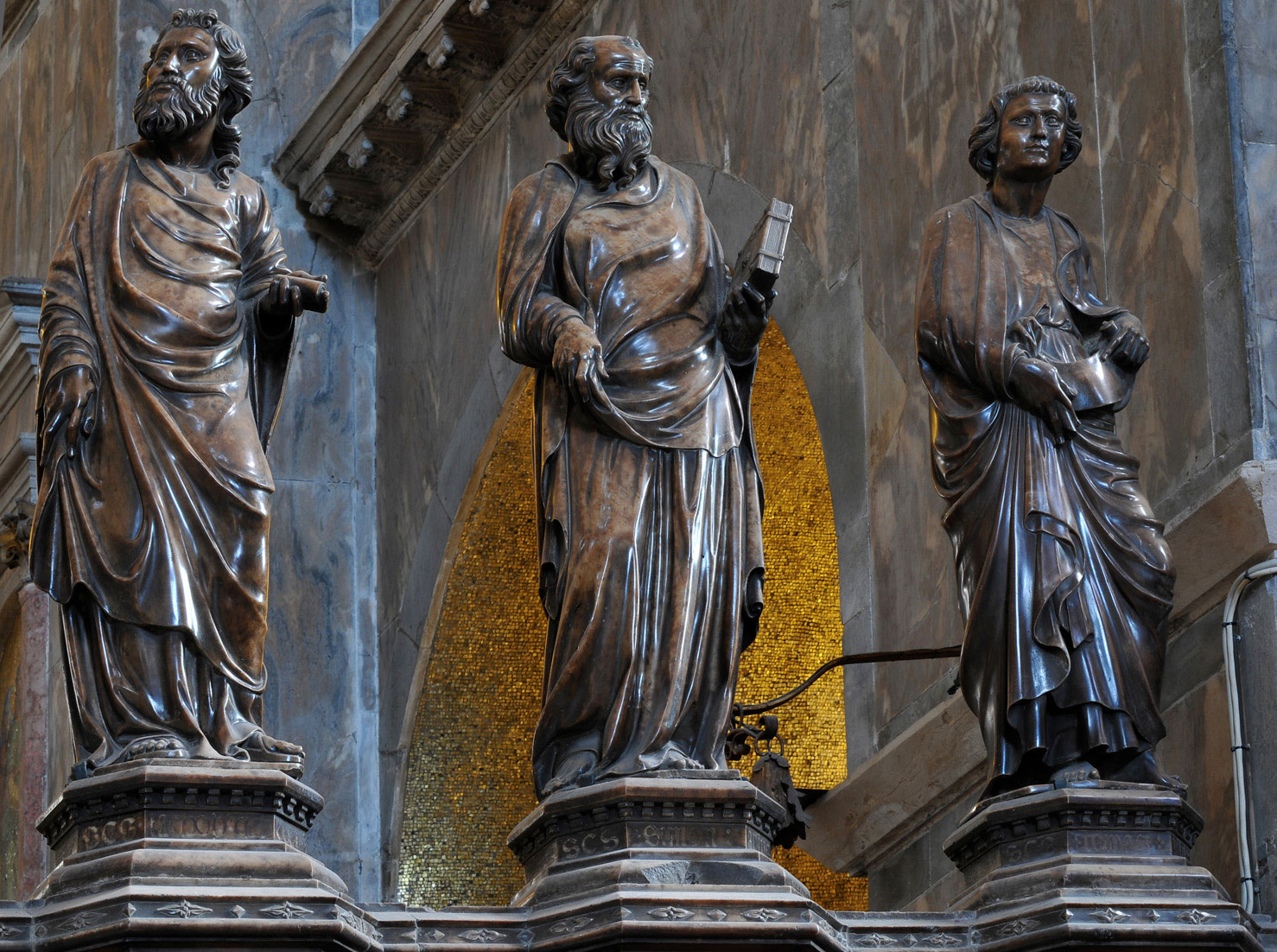
The current iconostasis consists of the 12 Apostles with the Virgin and St. Mark, each figure bears an inscription on the base indicating the Latin name attributable to the sculpture (St. Matthias, St. Philip, St. Thaddeus, St. Andrew, St. James the Greater, St. Peter, the Madonna, Christ Crucified, St. John, St. Mark, St. Matthew, St. Bartholomew, St. James, St. Simon, St. Thomas).
It is not possible to identify the individual figures without reservation, since, in some statues, the bases have been exchanged.
The sculptures are made of white marble but have a dark brown surface, likely caused by the smoke from candles placed between the figures. On the hems of the robes, there are notable remnants of the original polychrome, which repeats the rhombus motif found in the architectural part of the iconostasis.
The iconographic ensemble recalls that of the iconostasis of the old St. Peter’s in Rome, where, alongside the apostles, are several female saints. This reference is certainly not coincidental, and testifies to the Venetians’ intention to compete with the church of the Apostle in Rome.